“It’s breaking the laws of physics!”
Three boys shouted, splashed, and cheered as a piece of bark made its way- the WRONG way- upstream in a culvert. The culvert I almost didn’t let them near. Not because the creek was too deep. Not because it wasn’t structurally sound. Just because… well, because it wasn’t part of my plans today.
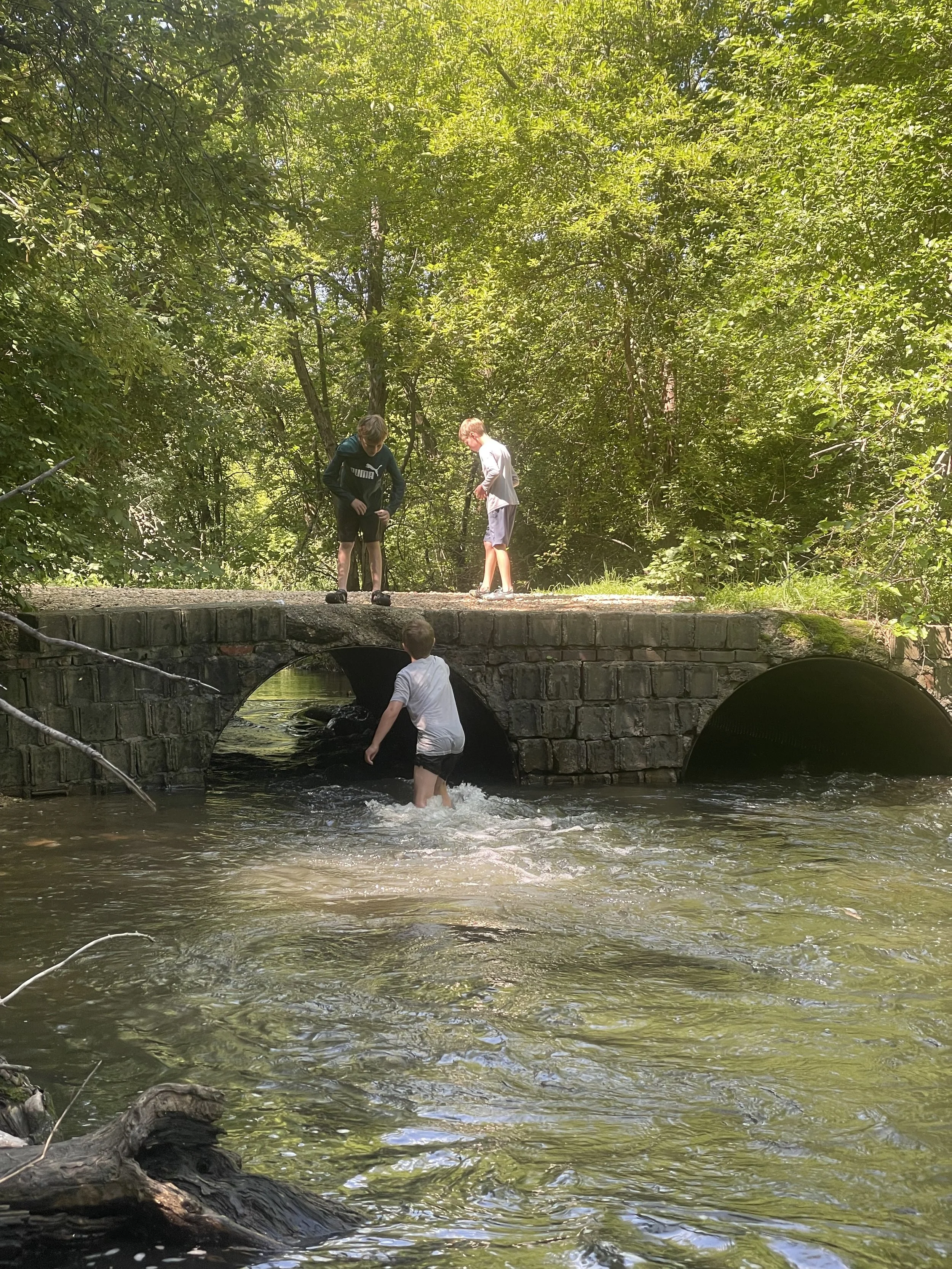
I’m a forest school teacher- I build child led exploration right into every class. But I also just hauled a heavy wagon with 10 carefully selected books, a tote of recycled materials and craft supplies, journals and markers, and diagrams of bees and flowers through the woods to teach a thoughtfully planned lesson on pollination to a group of 9-13 year olds. And I knew from the gleam in their eyes that there was no way this was going to be over in the 5 remaining minutes I’d allotted for exploration.
You see, the gleam in their eyes wasn’t from the discovery of the physics breaking piece of bark. That wasn’t going to come for forty whole minutes. The gleam was because they could clearly see to the bottom of the creek directly in front of the culverts- and they whipped their heads back at me with hopeful expressions: “Does this mean..?”.
It was week 2 of Forest School and the first day for “real” learning- the learning I’d so carefully planned out in the self-written curriculum I spent way too long developing. Week 1 was “Welcome to the Forest” and we focused on getting to know the layout of the woods we’d be learning in, following a few non-negotiable safety rules, and observing each students risk assessment and self-awareness skills. Their question was fair- one of our safety rules was this: You can explore the creek if.. you can see to the bottom and the depth does not rise above mid-thigh. All of week 1 the creek was deep and rushing in this area and exploring the culverts was a clear “no”- no one even asked. But today the water level was down significantly and moving much slower. We could see to the bottom on either side and I wasn’t sure when the next time the water level would allow us to explore this area. “Sure,” I smiled, thinking I could spare 5 additional minutes, “But only for 10 minutes- I have a really exciting activity about bees!”
Their exploration started off simple enough. “What are these giant pipes for?” and “Oh, look, our voices echo when we shout into them.” I thought it was just the novelty of their size and being up close to them when it previously was inaccessible. I gave them the good ol’ “two more minutes” and felt confident we would be able to move on in just a little while. But then one child said “see if you can catch this” and dropped in a stick. And the exploration deepened. Now their questions were evolving. “Why does it always come out of the left pipe?” and “Shouldn’t the bigger sticks pop out on the other side faster?”. They started using phrases like “the current” and theorizing explanations like “but this stick is dense”.
So I silently let the two minutes pass, telling myself I’d give them just a few minutes longer- they were asking such thoughtful questions and I liked hearing the peer-teaching that was going on.
But just as I opened my mouth to announce it was time to climb out of the creek, it happened again. Their exploration deepened. Two sticks of similar size and density dropped in simultaneously, one in each culvert- why does one side always win? Even when the stick is lighter? Heavier? Even when its thrown in versus dropped? I closed my mouth and gave them more time. And they shared reasonable explanations: “shallower,” “keeps bumping the sides,” “scraping along the bottom”.
This pattern continued- me, ready to continue with my plans, and them, shifting their focus and experiments in a way that I just couldn’t convince myself to cut short. Besides, I liked seeing their critical thinking skills developing in real time. It was for my benefit as much as theirs.
Then the shouting started: “WHAAAAAT?? How is it doing that?! It’s breaking the laws of physics!” The boys began chanting, then cheering for their piece of bark. “IT MADE IT!” they gushed, looking at each other in disbelief. Then immediately rushed off for more sticks and bark. I watched as their pure joy and utter amazement shone and then shone some more. They tested multiple pieces and found: if a piece of wood of the right size and density was placed just so at the exit of the culvert, it got sucked IN instead of pushed away. And some of the pieces would even be carried upstream all the way to the entrance of the culvert, before they turned around and came back. Rich debate ensued, but this time the boys could not agree on a reasonable explanation. Patterns? Yes. Theories? Yes. Their conclusion: the “pipes” are magic, have the ability to break the laws of physics, and we will be back to continue testing this.
Needless to say, we did not make it to my lesson on pollination. The boys can not tell me what a solitary bee is or label the anatomy of a flower. They can not tell me how the anatomy of bees, hummingbirds, and butterflies allow them to fulfill their role as a pollinator.
But… they experienced a phenomenon they could not explain. They experimented, theorized, tested, and came away with a feeling of awe at nature and an understanding that there are things in this world much bigger than themselves. They left with a commitment to return and test more theories and with a shared experience of joy and wonder.
Did I tell them that it certainly is not magic? Did I tell them I don’t know if water movement technically falls in the realm of physics and probably has its own subset of science rules and explanations?
No. No, I did not.
But I did do some research after my students were dismissed. And I do have a solid 7 books on their way to my local library on the topics of water currents, hydrology, the Eddy Effect, and (yes- they were technically correct!) physics.
These books will “magically” appear in our wagon next week and while students are rotating through whittling, painting, journaling, and book reading, they will stumble upon some coincidentally available materials.
….Which will almost certainly lead to a whole new set of experiments.